
Blog
Are Swarovski Crystal Tiaras Worth It? An Honest Answer From the Workbench

There is a moment in every tiara I make when I hold two stones up to the window, one in each hand, and they look identical. One costs four times the other. A bride would never tell them apart in the shop. But put them under the lights at eight in the evening, in a room with a photographer moving around, and one of them is still working and the other has gone flat.
That is the whole question behind “is a Swarovski crystal tiara worth it”, and almost nobody answers it properly, because the people answering are usually selling one thing or the other.
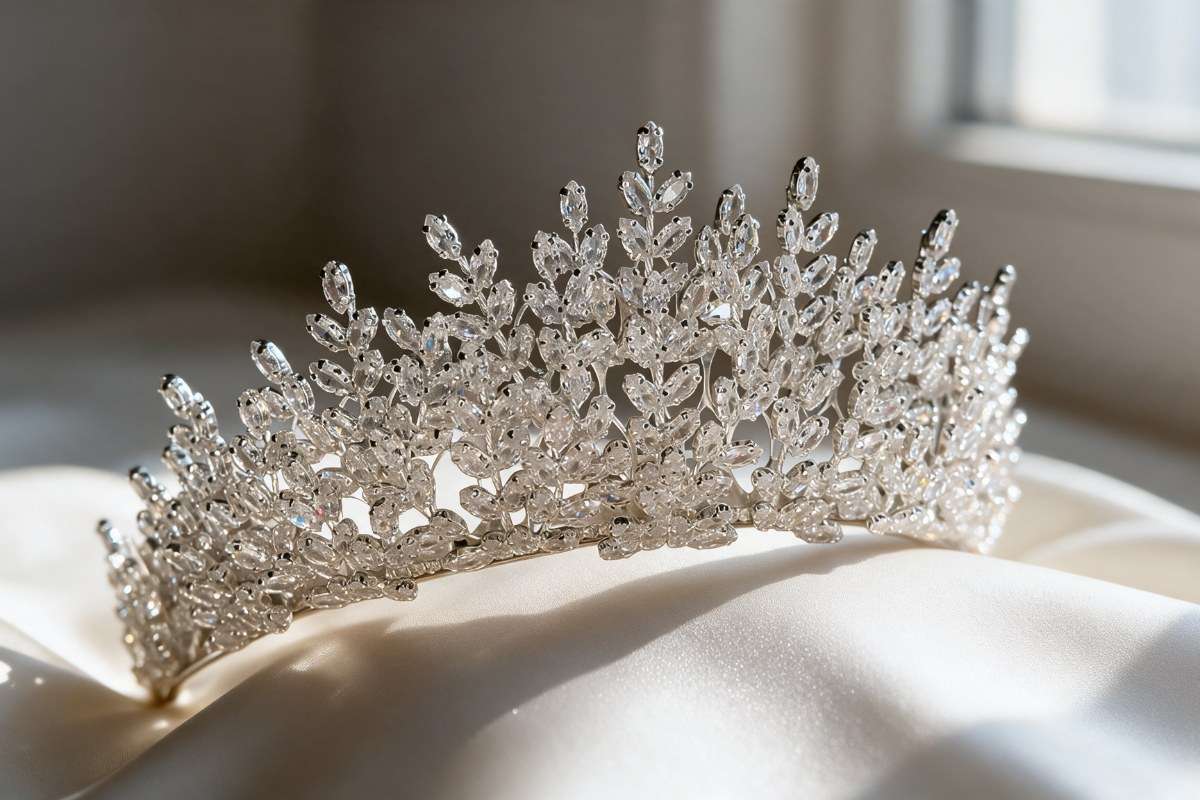
First, what a Swarovski crystal actually is
It is glass. That is not an insult, it is the point.
Ordinary window glass has almost no lead or barium in it, so light passes through and comes out much the way it went in. Crystal glass has those metals added, which slows light down inside the stone and splits it into colour on the way out. That split is the rainbow flash you see when a stone moves. In the trade it is called fire.
The second thing is the cutting. A Swarovski stone is machine cut to a precision that hand-cut glass does not reach, so every facet meets its neighbour at exactly the same angle across thousands of stones. That sounds like a detail. On a tiara with two hundred stones it is the difference between a line of light and a scatter of it.
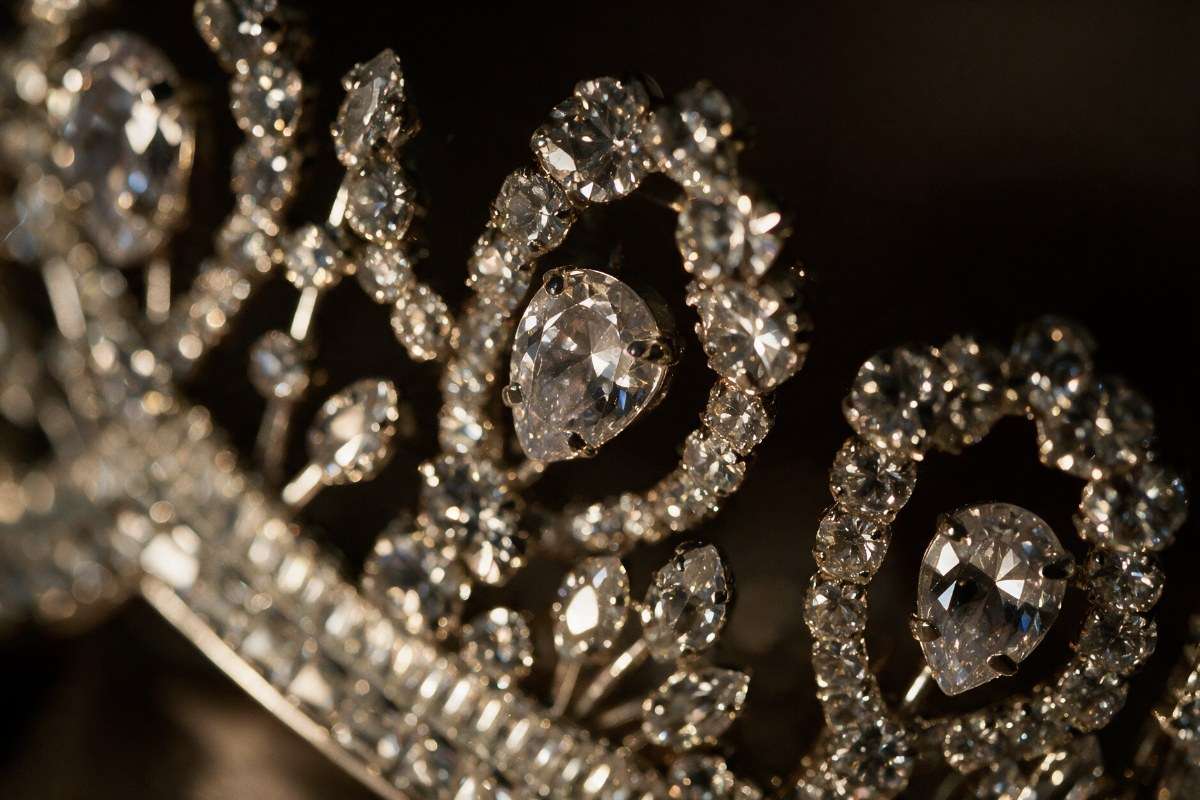
And what cubic zirconia is, since I use both
Cubic zirconia is not glass at all. It is a grown crystal, laboratory made, and it is much harder than glass — it will not scratch in a handbag on the way to the church, and it holds a sharper cut edge.
It also bends light more strongly than crystal glass does, which is why a cubic zirconia reads closer to a diamond in a photograph, while a Swarovski crystal reads brighter and more colourful to the naked eye.
In plain terms: cubic zirconia looks like a diamond. Swarovski crystal looks like light. They are not competing, they are doing two different jobs, and that is why most of what leaves my atelier uses both. I wrote a longer note on why I choose cubic zirconia if you want that side in detail.
The money, with real numbers
Here is the part nobody writes down.
- A bridal tiara set with plain moulded glass rhinestones: usually 30 to 70 dollars. Fine in photographs taken outdoors. Goes dull under evening light and the stones cloud within a year or two.
- A handmade tiara using Swarovski crystal and cubic zirconia on a silver plated base: around 240 dollars. That is where my pieces sit.
- A tiara set with real diamonds, even small ones: 4,000 dollars and upward, and usually far more. A one-carat total weight of tiny diamonds alone runs into the thousands before anyone has made anything.
So the honest comparison is not Swarovski against diamonds. Almost no bride is choosing between those. The real comparison is Swarovski against cheap glass, and the gap there is about 170 dollars.
What that 170 dollars buys you is: stones that still throw light at the reception, a piece that photographs without going grey, and something that survives being worn a second time at a sister’s wedding rather than living in a drawer looking tired.
Where the money really goes, and it is not the stones
I will be straightforward about this, because it changes how you judge the price.
The stones are not the expensive part of a handmade tiara. The labour is. A tiara with two hundred stones takes me most of two days, because every stone is set by hand and every wire is shaped and tightened individually. Machine-made tiaras with the same Swarovski crystals exist, and they cost less, and they are not as strong — the settings loosen because a machine cannot feel when a wire has taken enough tension.
So a cheap tiara with good stones is a real thing, and it is usually the setting that fails, not the stone. When you are comparing prices, ask what is holding the stones in, not only what the stones are.
So when is a Swarovski crystal tiara worth it?
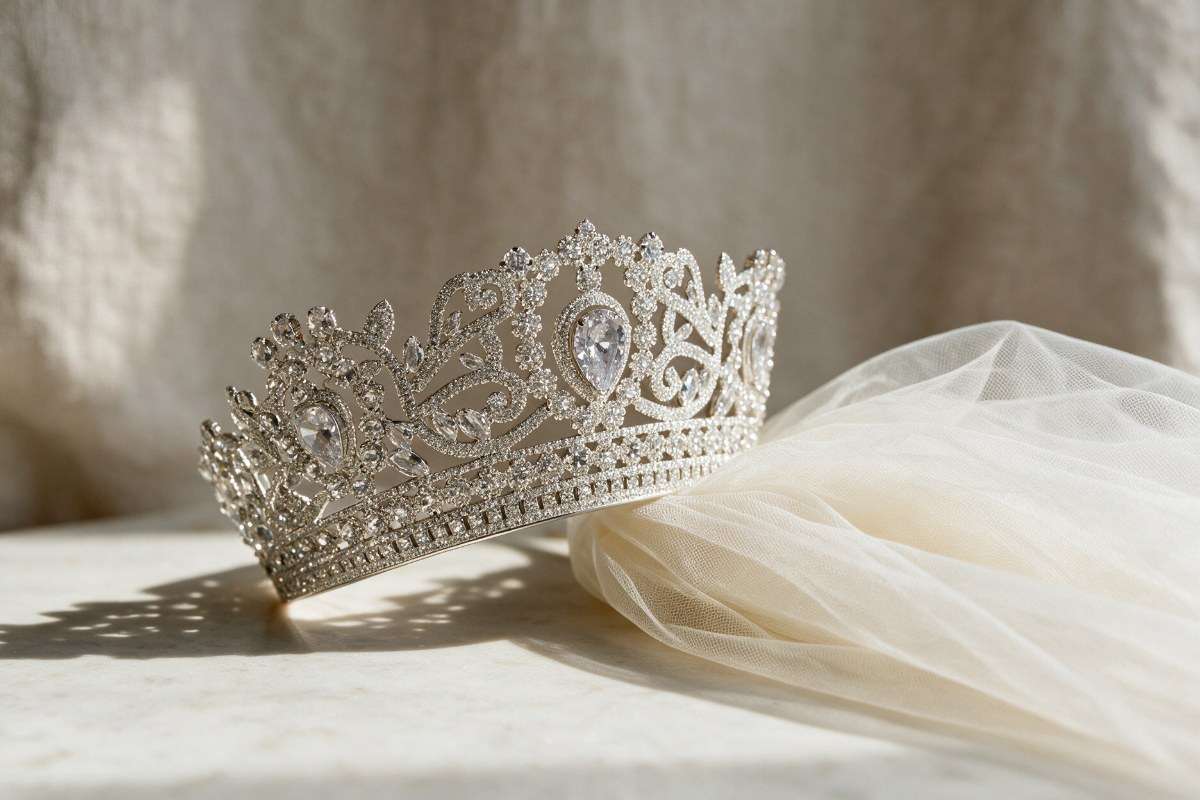
Four situations where I would tell a bride yes, without hesitating.
- Your reception is indoors or in the evening. Cut stones need a light source to work with. Under chandeliers or candles a Swarovski crystal tiara is visible from the far side of the room, and a moulded glass one is not.
- Your photographer shoots with flash. Flash is brutal on cheap stones — it shows the moulding seams and the flat tops. Precision-cut stones take flash and give it back.
- Your dress is simple. If there is nothing else catching light, the tiara has to carry it alone, and a weak stone will not.
- You want to keep it. A well-set tiara in crystal and cubic zirconia still looks right in twenty years. Moulded glass does not.
And two where I would honestly tell you not to bother.
- An outdoor daytime wedding with a pearl-heavy dress. Daylight is soft and diffuse, there is no point source for cut stones to catch, and pearls will do more for you. A pearl piece is the better spend.
- You are wearing the tiara for one hour under a veil, for the ceremony only, and taking it off. Nobody will see it work. Put the money in the earrings, which stay on.
How to tell a good stone from a bad one yourself
You do not need a loupe. Three tests, all of which you can do holding the piece.
- Tilt it slowly under a lamp. A good cut stone flashes in distinct points as it turns. A cheap one glows evenly and dully, like a wet pebble.
- Look at the edge of a stone from the side. Moulded glass has a faint seam, like the line on a plastic toy. Cut stones do not.
- Breathe on it. Fog clears fast off a hard stone like cubic zirconia, and lingers on glass. Not conclusive on its own, but it is quick.
What I actually make
Every tiara that leaves my Istanbul atelier uses Swarovski crystal and cubic zirconia on a silver plated base, set by hand, made to order in four to twelve working days, and shipped free. Most sit at around 240 dollars.
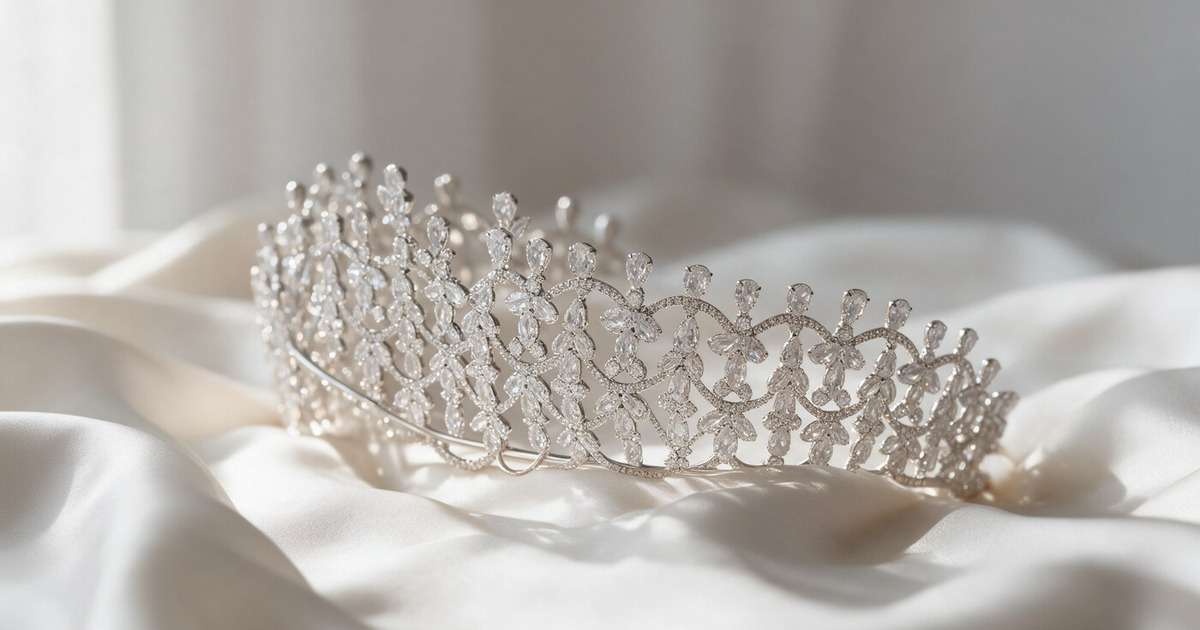
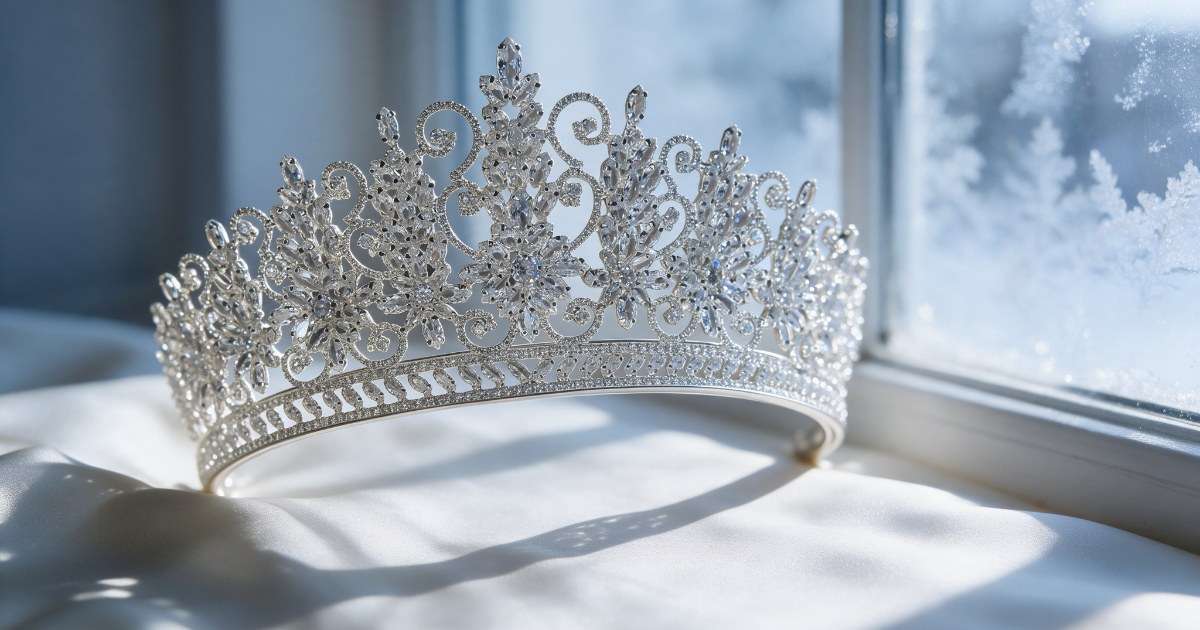
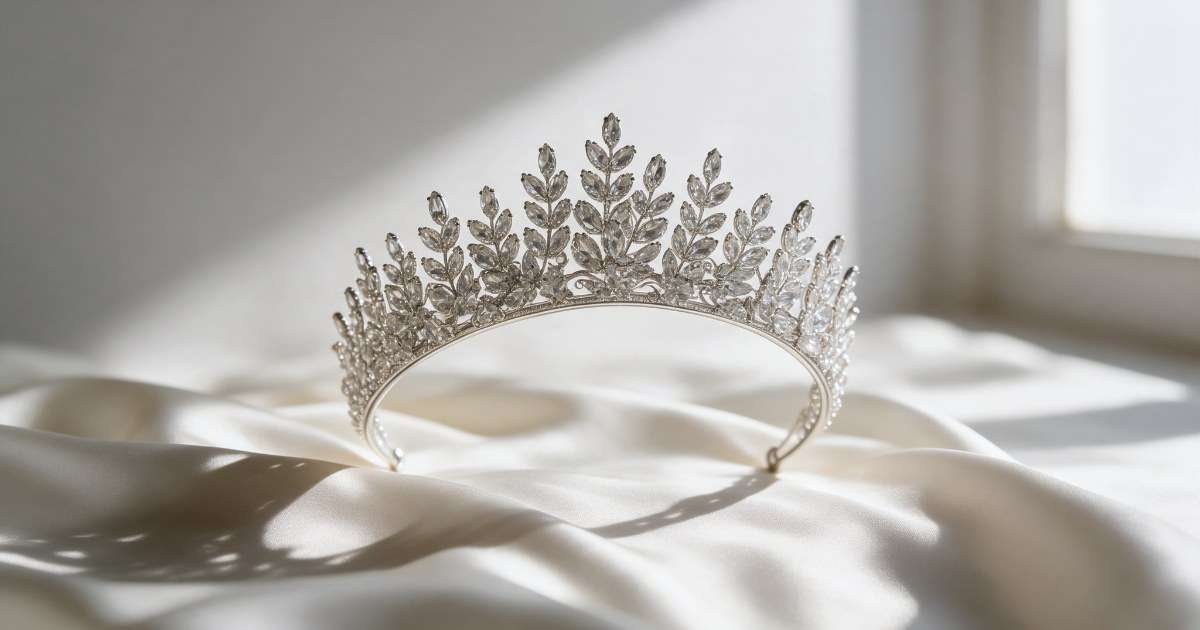
The one brides ask for most is the Swarovski crystal bridal tiara, which is built almost entirely of marquise cuts because marquise stones give the most light for their weight. If you want height and drama, the Queen Crown with teardrop stones is the fuller shape, about 5 cm tall. The whole tiara collection is here.
If you decide a tiara is not the right shape for your hair after all, I wrote about choosing a crystal headband instead, and about gold or silver once you have settled on the piece.
The short answer
A Swarovski crystal tiara is worth it if your light is artificial, your photographer uses flash, or you intend to keep the piece. It is not worth it for a soft daylight wedding where pearls would serve you better, or for an hour under a veil.
And whatever you decide, judge the setting as hard as you judge the stone. I would rather you bought a well-made tiara from someone else than a badly made one from me.
If you want a second opinion on a piece you have already found, send me the photograph. I will tell you honestly what I think is in it. I answer every message myself.