

Blog
The Braganza Tiara: A Glittering Giant of Royal History


Imagine a jewel so magnificent, so imposing, that it doesn’t just sparkle, it commands the room. In the world of royal jewelry, where delicate diadems and subtle headpieces often reign supreme, there is one piece that refuses to be subtle. It is the Braganza Tiara, often affectionately known as the “Brazilian Tiara.”
Weighing in with centuries of history and over a thousand diamonds, this isn’t just an accessory; it is a wearable monument to the grandeur of the 19th century. For jewelry lovers and royal watchers alike, the Braganza represents the pinnacle of “power dressing.”
A Gift of Love and Empire
The story of the Braganza Tiara begins not in the snowy palaces of Scandinavia, where it currently resides, but in the tropical heat of Rio de Janeiro.
Commissioned around 1829, this masterpiece was a wedding gift from Emperor Pedro I of Brazil to his second wife, Empress Amélie of Leuchtenberg. It was a tumultuous time for the Brazilian Empire, yet this tiara was created as a symbol of stability, wealth, and affection. When you look at old portraits or modern photographs of the piece, you aren’t just seeing diamonds; you are seeing a husband’s attempt to crown his wife with the very starlight of South America.
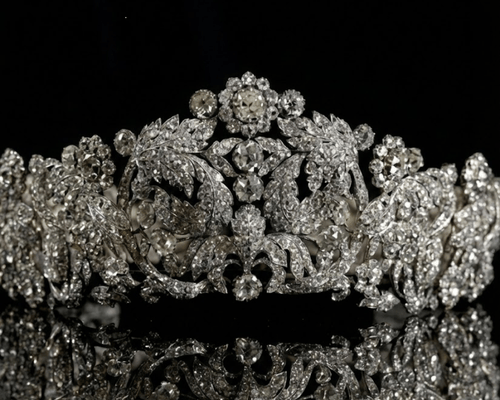
The tiara is a classic example of neoclassical design, featuring stylized leaves, flowers, and arabesques. But what makes it truly emotional is its journey. When Empress Amélie died without surviving children, she bequeathed her most precious treasures to her sister, Josephine, who happened to be the Queen of Sweden. Thus, the tiara traveled across the ocean, carrying the memories of a fallen empire to a new home in the north.
The “Heavyweight Champion” of Tiaras
To call the Braganza Tiara “big” is an understatement. It is massive.
In the world of gemology, it is often cited as weighing around three pounds (though likely slightly less in reality, it is still incredibly heavy for a headpiece) and stands roughly five inches tall. It is set with approximately 1,250 carats of diamonds.
Unlike modern tiaras, which are often convertible and can be worn as necklaces, the Braganza is a rigid, enclosed circlet. It sits on the head with the authority of a crown.
- The Centerpiece: The diamonds are set in gold and silver, creating a dazzling wall of light.
- The Feel: Wearing it requires physical strength and regal posture. It is a piece that demands respect from the wearer.
When a Queen wears the Braganza, she isn’t just attending a dinner; she is signaling that the event is of the utmost historical importance.
Queen Silvia’s Signature Piece
Today, the Braganza Tiara is the personal property of the King of Sweden, but it is exclusively worn by Queen Silvia. It has become her signature piece for the most grand and solemn occasions, particularly the Nobel Prize banquets and state visits.
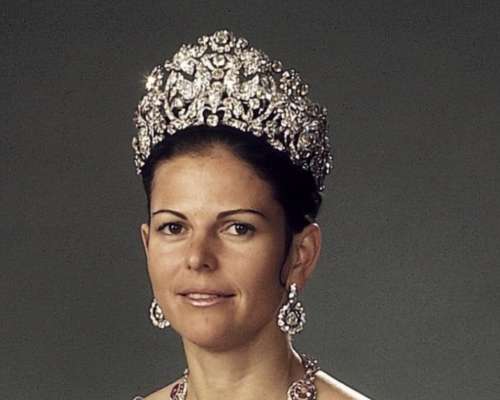
There is something deeply touching about seeing Queen Silvia wear this piece. She is known for her elegance and grace, and she carries the literal and figurative weight of this tiara with a smile. It is a symbol of the continuity of the Swedish monarchy—a French-made tiara, bought by a Portuguese Emperor for a Brazilian court, now worn by a German-Brazilian Queen in Sweden.
It is the ultimate heirloom, proving that while empires may rise and fall, beauty, and diamonds, truly are forever.
The Legacy of the Brazilian Tiara
Why does the Braganza Tiara captivate us? Perhaps it is because, in an era of minimalism, it is unapologetically opulent. It reminds us of a time when craftsmanship was about pushing boundaries and creating objects that could outlive their creators.
The Braganza is more than a collection of stones. It is a storyteller. It speaks of the sadness of Empress Amélie, the resilience of Queen Josephine, and the modern majesty of Queen Silvia. It is a reminder that behind every great jewel, there is a human heart that once beat a little faster at the sight of its sparkle.